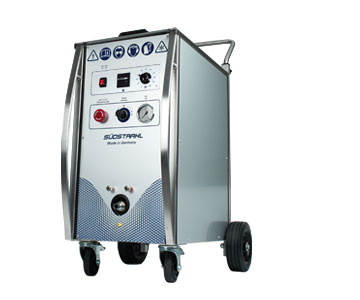
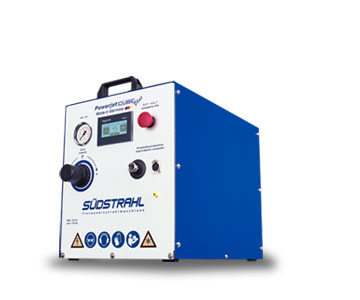
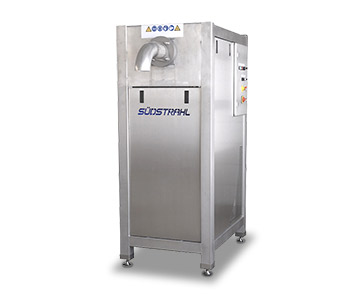
Dry ice blasting is a compressed-air blasting process in which solid carbon dioxide (dry ice) at a temperature of around -79°C is used as the blasting medium. The process covers a broad range of applications; dry ice is electrically non-conductive, chemically inert, non-toxic, and non-flammable. Unlike most other blasting methods, no blasting medium is left behind after cleaning that would need to be disposed of.
Chemical-free – no toxic or environmentally harmful solvents involved
Dry ice blasting was not originally developed for industrial cleaning in today's sense: an aircraft engine manufacturer was looking for a way to clean contaminated turbines without using water – this gave rise to the idea of targeting surfaces with dry ice pellets. It wasn't until the mid-1990s that the process reached the workshop market; the first commercial machines cost the equivalent of more than €30,000 at the time. Only with smaller, more affordable devices did the technology become accessible for wider commercial use – a trend that continues to this day.
Unlike purely abrasive blasting methods (sand, glass beads), several physical effects work together simultaneously in dry ice blasting:
1. Kinetic Effect
The dry ice pellets are accelerated through the nozzle by compressed air and hit the surface at high speed – practical values are around 150 meters per second. Despite this speed, the purely mechanical effect is comparatively low, since CO2 pellets with a hardness of only 1.5–2 on the Mohs scale are considerably softer than conventional blasting media such as sand or glass beads.
2. Thermal Effect (Embrittlement)
The abrupt cold shock causes dirt and coating layers to contract, become brittle, and lose their adhesion to the substrate. This is caused by the differing thermal expansion coefficients of the contamination and the base material – thermal stress builds up between the two layers, causing the dirt layer to detach while the workpiece itself barely reacts.
3. Sublimation (Micro-Blasting Effect)
On impact, the solid CO2 converts directly into a gaseous state without passing through a liquid phase – it sublimates. In doing so, its volume increases by roughly 700 to 1,000 times. This explosive volume expansion penetrates the brittle cracks created beforehand and effectively blasts the contamination off the surface.
This combination of mechanical and thermal energy explains why dry ice blasting achieves remarkably high cleaning performance despite the soft pellets, without abrasively attacking the base materials.
An informed decision on the right process depends on the substrate, degree of contamination, and desired result. Here are the key differences in detail:
Dry Ice Blasting vs. Sandblasting (Abrasive Blasting)
Sandblasting uses quartz sand, glass beads, corundum, or similar material, which is fired at the surface using compressed air and deliberately removes material. The result is a rough, textured surface that serves as an ideal base for new coatings – however, blasting media residue is always left behind and must be collected and disposed of, which keeps sandblasting a more affordable process.
Dry ice blasting, on the other hand, removes virtually no material, leaves no blasting media residue, and is therefore particularly suited to applications where the surface itself must not be altered. As a rule of thumb: sandblasting excels at heavy rust removal, thick old coatings, and where a roughened surface is desired; dry ice blasting excels when a surface needs to be cleaned – not deliberately treated or stripped.
Dry Ice Blasting vs. High-Pressure Cleaning
The key difference is water: high-pressure cleaning works with water and pressure, dry ice cleaning with solid CO2 and compressed air. This makes dry ice blasting the preferred choice for electronics, control cabinets, and all moisture-sensitive components – high-pressure cleaning also generates wastewater that must be collected and properly disposed of.
Dry Ice Blasting vs. Chemical Cleaning
Chemical cleaning methods use solvents that can be harmful to both employees and the environment, and leave behind residues that must be disposed of as hazardous waste. Dry ice blasting is entirely chemical-free.
An aspect that falls short with many providers, but is critical in practice:
CO2 and Risk of Asphyxiation
As soon as dry ice sublimates, gaseous CO2 is released – odorless, colorless, and heavier than air, meaning it can accumulate near the ground and in lower-lying areas. At a CO2 concentration of more than about 10% in the ambient air, there is an acute risk of asphyxiation. For this reason, adequate ventilation of work areas is essential, and in enclosed production areas a stationary gas detection system may be required to continuously monitor the atmosphere.
Legal Framework
In Germany, DGUV Information 213-115 "Working with Dry Ice" regulates the requirements for the production, storage, and use of dry ice in commercial settings.
Noise Protection
Sound pressure levels in dry ice blasting vary considerably depending on the machine, nozzle, and operating parameters – values between 75 and 125 dB(A) are common in practice; the industry-standard threshold for hearing protection under DGUV regulations is a maximum of 117 dB(A). Hearing protection is therefore mandatory for all blasting work.
Personal Protective Equipment
Safety goggles, hearing protection, protective gloves, a respirator, and closed protective clothing are standard for dry ice blasting – not only because of noise and CO2 exposure, but also due to the risk of cold burns from direct skin contact with the -79 degrees dry ice.
Consultation & needs analysis – Together we determine which machine, nozzle, and throughput suit your application, as well as whether purchase or leasing is the right choice for you.
Delivery & onboarding – After your order, we deliver your machine and support you in getting started, so you're ready to go right away.
Ongoing support – As a manufacturer with our own factory, we remain your direct point of contact for maintenance, accessories, and custom adaptations even after delivery.
We have compiled the answers to the most frequently asked questions about cleaning with dry ice and our dry ice blasting machines in Germany.
/
When used properly with the prescribed protective equipment and adequate ventilation, the process is safe. The primary hazard is not the dry ice itself, but the CO₂ gas released during sublimation, which can accumulate in poorly ventilated, lower-lying areas and pose a risk of asphyxiation.
Dry ice sublimates continuously – even under good storage conditions. As it ages, pellet density decreases, meaning more dry ice is needed to achieve the same cleaning performance. For optimal results, the freshest possible dry ice should be used.
Generally, no – since the dry ice sublimates immediately on impact and, with a hardness of only 1.5–2 on the Mohs scale, is considerably softer than conventional blasting media, the process is significantly gentler on materials than sand or glass bead blasting.
You can order dry ice from us or produce it yourself with your own dry ice pelletizer. The advantage of in-house production: you're independent of delivery times and always have access to fresh dry ice with maximum density and cleaning performance – important, since effectiveness declines as pellets age.
Under DGUV Regulation 1 and Section 5 of the German Occupational Health and Safety Act (Arbeitsschutzgesetz), employers are required to assess working conditions for employees and instruct them on the hazards associated with the task. Separate training on the safe handling of dry ice is therefore recommended.
Yes – outdoors, natural air circulation usually dilutes the released CO₂ gas more quickly. Even so, lower-lying, poorly ventilated areas such as pits or shafts should still be avoided outdoors.