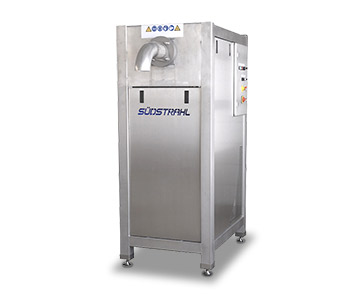
With Südstrahl's high-quality dry ice pelletizers, you produce dry ice yourself – always fresh, in the right pellet size, and independent of supply chains. Ideal for companies that regularly need dry ice for industrial cleaning, cooling, or special applications.
Dry ice is used in many ways, including for industrial cleaning, cooling, and numerous special applications. With Südstrahl´s dry ice pelletizers, you can produce dry ice yourself and make fresh pellets whenever you need them. This keeps you independent of supply chains and gives you full control over quality, pellet size, and production volume. Our machines enable efficient dry ice production right on site – ideal for companies that regularly need dry ice for industrial processes, cleaning, or transport.
Independent dry ice production offers you various other advantages in addition to the high flexibility in your daily workflow
Dry ice loses mass and density during transport. With your own pelletizers, you produce dry ice fresh and exactly when you need it, so your dry ice blasting machines always work at their best. This ensures top cleaning performance and consistent quality.
Producing your own dry ice eliminates transport costs, storage losses, and delivery times. At the same time, consumption drops, since less material is lost to sublimation.
With your own pelletizer, you produce dry ice exactly when you need it – independent of suppliers or market fluctuations.
Producing dry ice directly on site reduces transport distances and therefore CO2 emissions. It also means only the amount actually needed is produced.
Different pellet sizes (16 mm, 3 mm, down to 1.7 mm) enable tailored applications: from fine cleaning to cooling to transport solutions for delicate goods.
Want to produce your own dry ice?
For the use of the dry ice machine, you need not only the necessary space but also a liquid CO2 tank. In addition, we offer various press dies and other accessories to meet your individual needs in the best possible way.
SÜDSTRAHL products are manufactured in Germany, which enables us to guarantee the high quality of our equipment.
Do you have any questions about dry ice production, the purchase of pellets or costs? We are available for you at any time and will be happy to advise you personally at +49 7141.13381-10 or contact us conveniently via our contact form.
When buying a dry ice machine, production output, pellet sizes, and the reliability of the equipment play a decisive role above all. Südstrahl's dry ice pelletizers enable efficient and reliable production directly at your own facility. Thanks to their robust construction, high-quality stainless steel housing, and precise controls, our machines are specifically designed for industrial use. To operate the machine, you'll need not only the necessary space but also a liquid CO2 tank. We also offer various pressing dies and additional accessories to best meet your individual needs.
Planning your own dry ice production?
Our experts are happy to advise you on planning your setup and help you select the right dry ice pelletizer.
SÜDSTRAHL products are manufactured in Germany. This means our customers benefit from
direct support from the manufacturer
Do you have questions about dry ice production, purchasing pellets, or costs? We're available to you at any time and are happy to provide personal advice at +49 7141.13381-10, or you can conveniently contact us via our contact form.
Dry ice production is a physical process using liquid carbon dioxide (CO2). In a dry ice pelletizer, the CO2 is converted into dry ice snow and then pressed into pellets.
1. CO2 is liquefied: In the first step, carbon dioxide is put under pressure, causing the gas to liquefy. This liquid CO2 serves as the starting material for dry ice production and is fed into the pelletizer.
2. Pressure release: In the pelletizer, the liquid CO2 is released to atmospheric pressure. This causes the previously built-up pressure to drop suddenly.
3. Dry ice snow forms: Through this physical process, the remaining gas cools to -78.4 degrees and dry ice snow forms.
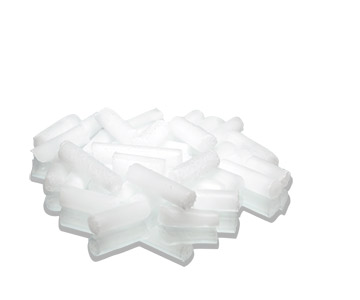
4. Pressing into dry ice pellets: The resulting dry ice snow is then compressed in the pelletizer and pressed into rod-shaped dry ice pellets.
5. Different pellet sizes for different applications: Südstrahl's dry ice pelletizers feature various pressing die inserts, allowing dry ice pellets to be produced with diameters ranging from 16 mm and 3 mm down to 1.7 mm.
This allows you to flexibly adapt dry ice production to your applications and always produce pellets in the right size.
We have compiled the answers to the most frequently asked questions about cleaning with dry ice and our dry ice blasting machines in Germany.
/
All our dry ice blasting machines are manufactured in our factory in Tamm near Stuttgart and are therefore "Made in Germany".
To produce dry ice, you essentially need a dry ice pelletizer along with a supply of liquid CO₂ (carbon dioxide). In addition, a CO₂ tank, suitable connecting lines, and — depending on the application — various pressing dies for different pellet sizes are required. We're happy to advise you comprehensively on our dry ice pelletizers and inform you about the necessary equipment and accessories.
All our units work with pellets in the thickness 1 to 3 mm dia.
No additional blasting agent such as sand or water is required. The dry ice becomes gaseous and flies. Therefore, disposal of the blasting agent is not necessary. With the dry ice blasting, sensitive surfaces can also be cleaned since the dry ice has a lower hardness than e.g. Sand. The dry ice blasting process can be adapted to the properties of the workpiece by adjusting the jet pressure and the quantity of ice. Only the removed contaminant material can be regarded as waste.
The dry ice is controlled in a controlled air stream. Due to the enormously high speed achieved by the air-ice mixture in the jet nozzle, the dry ice hits the contaminated surface, freezes the dirt and blows it off the surface. The solid dry ice evaporates and becomes gas. The gas is non-toxic and neutral. The removed dirt is carried away by the compressed air from the cleaned surface. The dirt can be sucked or filtered.